Undocumented Motherhood: Conversations on Love, Trauma, and Border Crossing

Claudia Garcia crossed the border because her toddler, Natalia, could not hear. Leaving behind everything she knew in Mexico, Claudia recounts the terror of migrating alone with her toddler and the incredible challenges she faced advocating for her daughter’s health in the United States. When she arrived in Texas, Claudia discovered that being undocumented would mean more than just an immigration status—it would be a way of living, of mothering, and of being discarded by even those institutions we count on to care.
Elizabeth Farfán-Santos spent five years with Claudia. As she listened to Claudia’s experiences, she recalled her own mother’s story, another life molded by migration, the US-Mexico border, and the quest for a healthy future on either side. Witnessing Claudia’s struggles with doctors and teachers, we see how the education and medical systems enforce undocumented status and perpetuate disability. At one point, in the midst of advocating for her daughter, Claudia suddenly finds herself struck by debilitating pain. Claudia is lifted up by her comadres, sent to the doctor, and reminded why she must care for herself.
A braided narrative that speaks to the power of stories for creating connection, this book reveals what remains undocumented in the motherhood of Mexican women who find themselves making impossible decisions and multiple sacrifices as they build a future for their families.
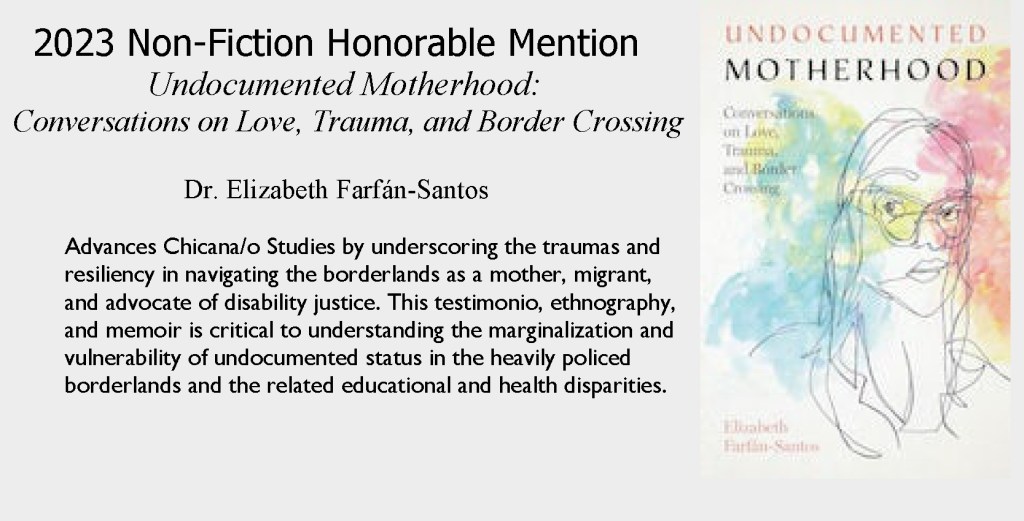
NACCS-Tejas Foco 2023 Non-Fiction Book, Honorable Mention
~ Reviews ~
“One of the defining features of Undocumented Motherhood is how lovingly its assembled. While Farfán-Santos struggles with her role as a chronicler of stories, writing “Maybe I should call myself a wound-poker instead of an anthropologist” the care and respect she has for the women she interviews shines through like warm light from a busy kitchen. ”
— Julie Poole, Sight Lines Magazine
“Farfán-Santos movingly describes how the Latinx community comes together to help their own and makes a powerful case that the traumas of migration manifest themselves in the bodies of immigrants. This is a stirring portrait of pain and perseverance.”
— Publisher’s Weekly
“Farfan-Santos is a beautiful storyteller who weaves together two dynamic transborder migration stories to reveal how undocumented mothers navigate unjust state systems. Fear and sacrifice shape the maternal experience highlighted in this book but so do love, commitment, comadrazgo, and radical aguante. An important book for all readers to understand how immigration policy deeply impacts the everyday existence and mobility of families on either side of the US/Mexico border.”
— Dr. Michelle Tellez, University of Arizona, author of Border Women and the Community of Maclovio Rojas
Black Bodies, Black Rights: The Politics of Quilombolismo in Contemporary Brazil

Under a provision in the Brazilian constitution, rural black communities identified as the modern descendants of quilombos—runaway slave communities—are promised land rights as a form of reparations for the historic exclusion of blacks from land ownership. The quilombo provision has been hailed as a success for black rights; however, rights for quilombolas are highly controversial and, in many cases, have led to violent land conflicts. Although thousands of rural black communities have been legally recognized, only a handful have received the rights they were promised. Conflict over quilombola rights is widespread and carries important consequences for race relations and political representations of blackness in twenty-first century Brazil. Drawing on field work in a quilombola community, Elizabeth Farfán-Santos explores how quilombo recognition has significantly affected the everyday lives of those who experience the often-complicated political process. Questions of identity, race, and entitlement play out against a community’s struggle to prove its historical authenticity—and to gain the land and rights they need to survive. This work not only demonstrates the lived experience of a new, particular form of blackness in Brazil, but also shows how blackness is being mobilized and reimagined to gain social rights and political recognition. Black Bodies, Black Rights thus represents an important contribution to the rapidly growing interdisciplinary field of Afro-Latino studies.
~ Reviews ~
“[A] brilliantly researched and argued book…a much-needed investigation of the differences between how state actors understand ideas of black land rights and how an Afro-Brazilian community effectively makes space on their own terms and in the process maintains a centuries-long commitment to sustaining themselves amidst racialized poverty.”
— Adam Bledsoe, AAG Review of Books 2019-01-15
“Black Bodies, Black Rights is…a case study of bureaucracy, race, power, and wealth in contemporary Brazil. For anyone who wants an illuminating look [on] these phenomena at the grass-roots level, this is the book to read.”
— (Bulletin of Latin American Research 2018-01-05)
“The drama of resistance and rebellion to enslavement and the odyssey of transformation from enslaved Africans to rights-bearing subjects make for a terrific narrative, highly accessible to a general readership.”
— Charles Hale, Professor of Anthropology
“I consider this book important supplementary reading for students in health and human sciences, professionals [in these fields], and required reading on health inequities and the promotion of racial equality in Brazil”
— Aline Ferreira, Ciencia & Saude: Journal of the Brazilian Association of Collective Health 2017, translation mine
 Elizabeth Farfán-Santos